
Bangladesh-China and Bangladesh-US relations have evolved from reluctant engagement to increasingly consequential strategic partnerships.

One in 10 employees at California-headquartered technology unicorns now work from India, surpassing other major US tech hubs and several countries, driven by US visa restrictions and substantial cost savings.

As India's decline continued on global indices, the government first blamed methodology and then motives. This is where we remain today as we wish each other and ourselves a happy Independence Day, points out Aakar Patel.

The US Supreme Court is poised to rule on the legality of state laws in West Virginia and Idaho that ban transgender student athletes from female sports teams. This contentious issue, deeply embedded in the nation's culture wars, challenges federal anti-discrimination laws and the Constitution's equal protection clause.

By all available indications, the White House drafted a face-saving note and handed it, ready-made, to Islamabad. Pakistani Prime Minister Shehbaz Sharif was supposed to then post it in the guise of a plea urging Trump to extend the deadline by two weeks 'to allow diplomacy to run its course'. Trump would then graciously accept Pakistan's 'request' and declare a ceasefire. Sharif dutifully posted the message on X. Except that he, or whoever was handling the account, forgot to delete the tell-tale first line visible in the edit history: 'Draft - Pakistan's PM Message on X'. Prem Panicker's must read blog on the Iran War.

Legendary economist and former Federal Reserve chairman Alan Greenspan has died at the age of 100 due to complications related to Parkinson's disease, his wife Andrea Mitchell confirmed.

Thousands of yoga enthusiasts across the world marked the International Day of Yoga on Sunday, as Indian missions abroad organised events to highlight the ancient practice's role in fostering health and well-being.

India too can rise to the top if the 1.4 billion Indians back home are given better opportunities to use their innate talent and capacity to work hard, with right incentives in a more meritocratic rules-based system, asserts Ajay Chhibber.

Sanju Samson heads into the second T20I against England with his place under the spotlight, as teenage sensation Vaibhav Sooryavanshi waits in the wings after another underwhelming outing from the India opener.

At The Odyssey's Mumbai press conference with Christopher Nolan and the cast.

Beijing clearly intends to extend the China-Myanmar Economic Corridor to Bangladesh as part of its larger Maritime Belt and Road Initiative to boost its Indian Ocean presence.

What we are watching is something different: A fog manufactured and maintained by the people who started the war, so that the question of why it was started never has to be answered, observes Prem Panicker in his must read blog on the war in the Middle East.

'Actual implementation of the 14-point agreement is proving hard to achieve let alone striking and sustaining a long-term treaty or deal.'

The US Congress has paid tribute to the late Indian-American entrepreneur Sivaramakrishnan Somasegar, known as 'Soma', for his significant contributions to Microsoft and the broader technology sector. Congresswoman Suzan DelBene highlighted his impactful career at Microsoft, his role in fostering new startups, and his community involvement, including co-founding the Seattle Orcas cricket team.

If we really want to curb the further depreciation of the rupee and make the rupee appreciate, we want to come out of the mindset that the exchange rate is merely a number, bring policy corrections to help reduce the outflow of foreign exchange by imposing suitable tariffs to discourage imports and bring self reliance, discipline FPIs, and correcting rules governing royalty outflows, suggests Dr Ashwani Mahajan, National Co-Convenor, Swadeshi Jagaran Manch.

Author of over 100 books, he served as the secretary general of Lok Sabha from 1983 to 1990.

Israel's Defence Minister Israel Katz declared that the Israeli military will not withdraw from its security zones in Lebanon, Syria, and Gaza, directly opposing the newly announced American-led diplomatic framework with Tehran. National Security Minister Itamar Ben-Gvir further asserted Israel's sovereignty, stating, "Trump's agreement does not bind us. Israel is not subject to the United States, and we are an independent and sovereign nation!"

The 42-year-old, who has had stints at Microsoft, Facebook and Twitter, made the announcement of leaving his role as Senior Policy Advisor for Artificial Intelligence in a post on X on Saturday.

Iran's World Cup campaign has left many Iranian-Americans torn between supporting Team Melli and opposing the country's leadership, highlighting deep divisions within Los Angeles' influential Iranian diaspora.

Climate change has increased the likelihood of temperatures high enough to affect player performance at 97 of the 104 tournament matches.

Indian benchmark indices Sensex and Nifty closed marginally lower due to profit-taking, following the Reserve Bank of India's decision to keep the repo rate unchanged while lowering its growth expectations for the current fiscal year and forecasting higher inflation.

The 2026 FIFA World Cup, co-hosted by the United States, Mexico, and Canada, is set to be football's largest tournament but will unfold against a backdrop of significant geopolitical tensions, including conflicts, strained alliances, and complex immigration policies, challenging its traditional role as a symbol of global unity.

The outreach comes amid a drop in Indian student enrolments in management programmes at American universities last year, following changes to US student visa policies.

Asha Bhosle has given us eight decades of songs to remember her by. She made many public appearances in India and abroad, taking music forward and showing audiences a side to her that they had never seen before. Here's a look at The Legend through the years from our archives.

India emerged reasonably well from 2025. But now, the oil shock and war-related supply disruptions have again driven funds out of India and significantly weakened the rupee, points out Ajay Chhibber.

Iranian foreign ministry spokesperson Esmaeil Baghaei said that the country has held no "direct" talks with the United States as of now and added that it has received messages through some mediators regarding the US' desire for negotiations.
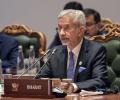
India has expressed serious concerns about the West Asia crisis and its potential impact on energy supplies and maritime stability, urging BRICS nations to find practical solutions to geopolitical challenges and unilateral sanctions.
'Once the currency goes out of the hand, then possibly your major challenge is that it will not come back.'

A new study reveals that human cells, including cancer cells, possess the ability to sense their environment far beyond their immediate point of contact, potentially influencing cell movement and cancer spread.
A new study reveals that human cells, including cancer cells, possess the ability to sense their environment far beyond their immediate point of contact, potentially influencing cell movement and cancer spread.

...reopen for up to six months. Until then, the Strait stays nearly closed. The world pays. And no one, including the man who started this, can say when it ends, notes Prem Panicker in his must read blog on the Iran War.

China has established a new county in Xinjiang province near Pakistan-occupied Kashmir (PoK) and the Afghanistan border, a move seen as strengthening security along the Wakhan Corridor and addressing concerns about Uyghur separatist militants.

Indian-American scientist Amit Kshatriya's journey from watching rocket launches in Houston to becoming NASA's Associate Administrator is a testament to his dedication and expertise in space exploration.

Karex, the Malaysian company that makes roughly one in five of the world's condoms -- about five billion a year, supplying Durex and Trojan among others -- announced this week that it is raising prices by up to 30 percent. The reason is the Strait of Hormuz.

Both sides have now revealed a preference for escalation over strategic defeat, and each new provocation narrows the space for the next pause. The Touska seizure, Iran's refusal to negotiate under blockade, Israel's strikes on Iranian oil infrastructure -- all of these add up to an increasingly untenable situation. This makes the wild card -- Trump and his motormouth -- more consequential than ever, notes Prem Panicker in his must read blog on the Iran War.

Chaffing under public ridicule in the US as well as internationally for having 'lost' the war, Trump is under immense pressure to do something, cautions Ambassador M K Bhadrakumar.

Nobody takes Pakistan seriously and therefore Pakistan's sudden mediating with almost immediate results of a ceasefire seems more contrived than real, points out Vice Admiral Biswajit Dasgupta (retd).

The question is whether the clocks allow enough time for two deeply mistrustful sides to get there, and whether the surface calm holds long enough for the paddling to produce something before the ceasefire ends on April 22, notes Prem Panicker in his must read blog on the Iran War.

April Fools' jokes and clever tricks have entertained people and baffled the public at large for centuries.

'It was diminishing even before Trump came to power.' 'The US was at the centre of the global economy. That position is going to become less and less important and less central.'
